
The evolution of SEO explains why SEO advice from five or ten years ago can sound completely different from what SEO professionals recommend today.
SEO has changed because search engines have changed.
What is SEO?
SEO, or Search Engine Optimization, is the process of improving a website so search engines can find, understand, index, and present its content to relevant users.
Years ago, SEO focused heavily on keywords, links, and traditional search rankings. Modern SEO still uses those foundations, but the work now includes search intent, content quality, technical performance, entities, user experience, structured data, and visibility within AI-powered search experiences.
That change is the evolution of SEO.
SEO is no longer only about getting a blue link into Google’s top 10 results. It is about making your website understandable and useful wherever people search for information.
How Does SEO Work?
Google Search mainly works through three broad stages: crawling, indexing, and serving search results.
Googlebot discovers pages through links, sitemaps, and other signals. Google then processes eligible pages and may add them to its index. When someone searches, Google’s systems select results that appear relevant to the query.
Google states that most pages appearing in Search are discovered automatically by its web crawlers rather than manually submitted.
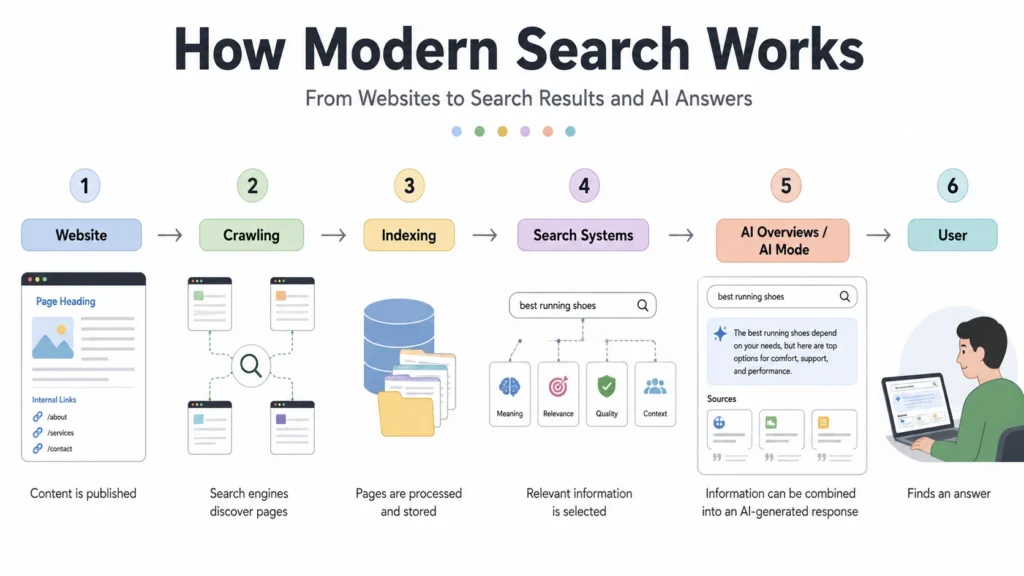
SEO helps throughout that process.
An SEO professional may work on:
- crawlability and indexing
- website architecture
- keyword and topic research
- search intent
- on-page optimization
- internal linking
- content quality
- backlinks and brand mentions
- structured data
- page experience
- Core Web Vitals
- local search visibility
- AI search visibility
The goal is not to manipulate a search engine. Good SEO makes useful information easier for search systems and people to find and understand.
SEO Then and Now: What Actually Changed?
The easiest way to understand how SEO has changed is to compare traditional SEO with modern SEO.
SEO Then | SEO Now |
Exact keywords were a major focus | Topics, entities, context, and intent matter |
Keyword density received heavy attention | Natural topical coverage matters more |
Link quantity was often pursued | Link relevance and quality matter more |
Ranking #1 was a main goal | Visibility can happen across many search features |
Content often targeted one keyword | Pages can answer related queries and subtopics |
Desktop search dominated early SEO | Mobile usability is now expected |
Search meant traditional results | Search now includes AI Overviews, AI Mode, Maps, images, video, and more |
SEO reporting centred on rankings | Traffic, conversions, visibility, engagement, and business outcomes also matter |
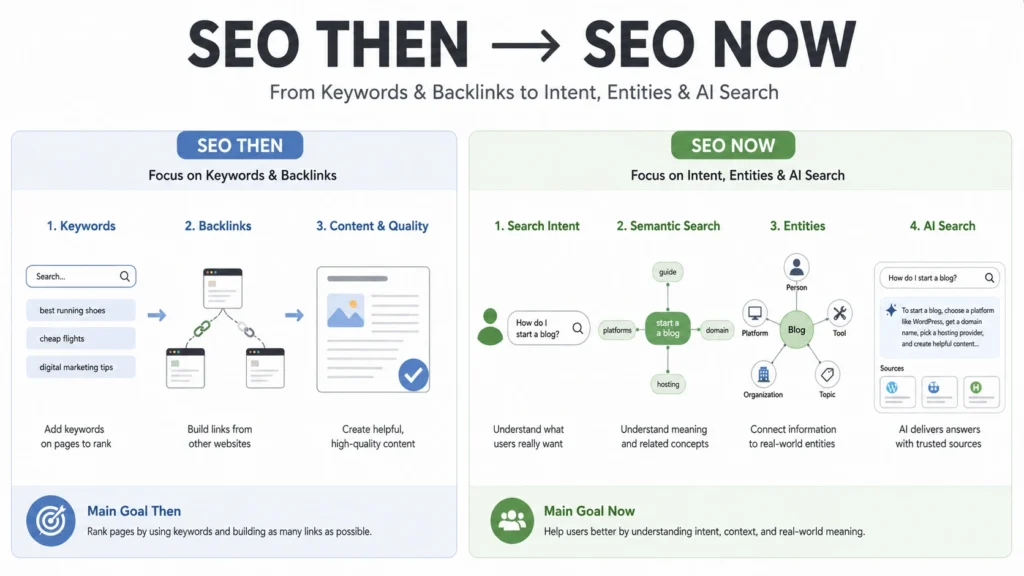
Traditional SEO was often treated like a formula.
Put the keyword in the title. Repeat it several times. Build links. Try to move the page higher.
Modern SEO requires a better understanding of the person behind the query.
If someone searches “best way to improve local business visibility,” Google does not simply look for the page that repeats that phrase the most. Search systems try to identify pages that can satisfy the person’s need.
How Search Engines Have Changed
Google has spent years moving from basic keyword matching toward systems that can better interpret language, context, quality, and meaning.
That shift changed SEO.
A modern search engine needs to understand relationships.
For example:
SEO → technical SEO → crawling → indexing → Google Search Console
These concepts are related.
Another relationship could be:
local SEO → Google Business Profile → reviews → Maps → local customers
Modern content should make relationships like these clear.
This is one reason entity-based SEO and semantic search receive much more attention today. A search engine needs to understand what a page is about, which people or organizations are mentioned, and how the information relates to the searcher’s question.
Keywords still matter.
But keywords are now part of a much larger picture.
Modern SEO Is Built Around Search Intent
One of the biggest changes in the evolution of SEO is the focus on why someone searches.
Consider these searches:
“what is SEO”
“how does SEO work”
“SEO expert in Kerala”
“SEO audit service”
All four relate to SEO, but the intentions are different.
The first search is educational.
The second asks for an explanation.
The third may indicate someone looking for a professional.
The fourth may indicate someone looking for a specific service.
Modern keyword research therefore needs more than search volume.
I look at the SERP, the type of pages Google currently returns, related questions, business relevance, and what the searcher probably wants to do next.
That approach changes how pages are planned.
An informational query may need a blog article.
A service query may need a service page.
A location-based query may need local SEO signals and a Google Business Profile.
You can see how I apply these different areas across my SEO services.
Technical SEO Still Matters
AI has changed search, but it has not removed the technical foundations of SEO.
A search engine still needs access to a page before that page can appear in search results.
Technical SEO deals with issues such as crawl access, indexing, canonicalization, internal linking, site architecture, structured data, mobile usability, and performance.
Google’s current documentation says a page must be indexed and eligible to appear in Search with a snippet before it can be eligible as a supporting link in AI Overviews or AI Mode.
That point matters.
You cannot separate AI search optimization from basic SEO.
Core Web Vitals also remain useful measurements of real-world page experience. Google currently recommends an LCP within 2.5 seconds and an INP below 200 milliseconds for a good user experience.
Tools such as Google Search Console, Google Analytics, PageSpeed Insights, Ahrefs, Semrush, Screaming Frog, and Rich Results Test can help SEO professionals identify different types of problems.
Content SEO Has Moved Beyond Keyword Density
Older SEO discussions often asked:
“How many times should I use my keyword?”
That is the wrong question for most modern content.
A better question is:
“Does this page give the searcher enough useful information to satisfy the query?”
A strong page about technical SEO might naturally discuss crawling, indexing, robots.txt, XML sitemaps, canonical tags, internal links, Search Console, structured data, and Core Web Vitals.
Those terms belong together because the concepts belong together.
The page does not need to force the exact phrase “technical SEO” into every paragraph.
Google’s guidance for AI search continues to recommend unique, useful content made for people rather than content created mainly to satisfy a search system.
This is also where first-hand experience can add value.
I have worked across different SEO projects and a lot of SEO audits. In real audits, ranking problems rarely come from one missing keyword. They are often connected to several issues, such as weak intent matching, poor internal links, indexing problems, thin service pages, or weak local signals.
Structured Data Helps Search Engines Understand Pages
Schema markup gives search engines explicit information about a page.
For example, structured data can identify information about an organization, article, product, event, recipe, or local business.
Google uses Schema.org vocabulary for much of the structured data supported by Search. Valid markup can also make certain pages eligible for rich results.
Schema does not automatically give a page higher rankings.
Its main SEO value is clarity and eligibility for supported search appearances.
That distinction matters because modern SEO is increasingly about making information understandable to machines without making the writing unnatural for humans.
AI and SEO: Search Is Becoming an Answer Experience
AI search is one of the biggest changes happening in SEO.
Google Search now includes AI Overviews and AI Mode. People also use systems such as ChatGPT, Gemini, Claude, and Perplexity to find information.
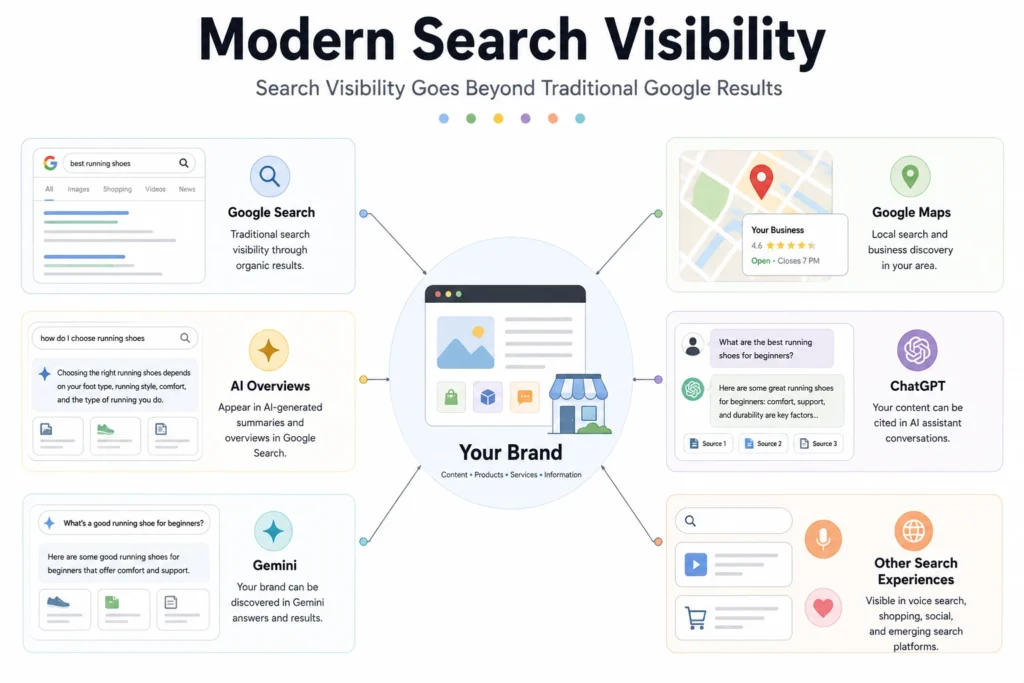
Google says AI Overviews and AI Mode can use a technique called query fan-out. The system may issue multiple related searches across subtopics and data sources while generating a response.
Google’s generative AI optimization documentation also explicitly discusses retrieval-augmented generation, or RAG. Google describes RAG as a grounding technique that can retrieve relevant and current web pages from its Search index to support generated responses.
That creates an important change in how SEO professionals should think about visibility.
A page may need to be useful not only as a full document but also at the passage level.
Clear headings help.
Direct answers help.
Self-contained paragraphs help.
Strong entity relationships help machines interpret the subject.
Good internal linking helps search systems discover related information.
None of these ideas require writing robotic content.
They require clear writing.
Example: One Query Can Become Several Searches
Imagine someone asks an AI search system:
“How can a small restaurant in Kerala get more customers from Google?”
A useful answer may require information about several connected subjects:
- local SEO
- Google Business Profile
- restaurant keywords
- customer reviews
- Google Maps
- local citations
- website optimization
- location pages
An AI system may retrieve information from several sources before generating its answer.
That is different from the older idea of optimizing one page around one exact keyword.
Modern SEO therefore benefits from strong topical relationships across a website.
A restaurant SEO page should connect naturally with local SEO, Google Business Profile optimization, reviews, location signals, and relevant service information.
This principle applies whether your audience is in Kerala, the UAE, London, or another market. The location changes the search behaviour and competition. The foundation remains relevance and usefulness.
Does E-E-A-T Matter in Modern SEO?
E-E-A-T stands for Experience, Expertise, Authoritativeness, and Trustworthiness.
Google added the additional “E” for Experience to its Search Quality Rater Guidelines in 2022. Google also states that these guidelines help evaluate search systems and do not directly determine rankings.
For content creators, the practical lesson is simple.
Show why readers should trust the information.
An SEO article can do that by using real examples, explaining actual workflows, citing reliable sources, identifying the author, and avoiding claims that cannot be supported.
Is SEO Still Relevant in the Age of AI?
Yes. Google itself answered this question in its 2026 guidance for generative AI search. The company states that established SEO practices remain relevant because its generative AI search features are connected to Google’s existing Search ranking and quality systems.
Google also held about 91.27% of worldwide search engine market share in June 2026, according to Statcounter.
SEO is not disappearing.
The places where SEO can create visibility are increasing.
A modern SEO strategy may consider:
- traditional organic results
- AI Overviews
- AI Mode
- Google Maps
- image search
- video search
- rich results
- conversational AI systems
The job is moving from “How do I rank this keyword?” toward “How do I make this brand and its information easy to find, understand, trust, and retrieve?”
What Is the Future of SEO?
The future of SEO will probably involve a closer relationship between traditional search and AI-generated answers.
Technical accessibility will still matter.
Useful content will still matter.
Authority and trust signals will still matter.
But SEO professionals will increasingly need to think about entities, passages, structured information, multimodal content, retrieval systems, and how AI systems select supporting sources.
Google’s May 2026 guidance also makes an important point: website owners do not need to abandon established SEO principles simply because generative AI has entered Search.
Modern SEO is an extension of the fundamentals, not a replacement for them.
Final Thoughts
The evolution of SEO tells a simple story.
SEO started with a stronger focus on keywords, links, and rankings. Search systems became better at interpreting language, context, quality, entities, and user intent. AI search is now adding another layer to that process.
The fundamentals have not disappeared.
Search engines still need to find your pages.
They still need to understand your content.
People still need a reason to trust what they read.
The difference is that your information can now be discovered through more search experiences than before.
For businesses, that means SEO should no longer focus only on ranking a list of keywords. The goal should be useful and trustworthy visibility across Google Search, Maps, and relevant AI-powered search experiences.
If you want to know how your website currently performs across these areas, you can get in touch for an SEO audit.
Frequently Asked Questions About the Evolution of SEO
What is SEO in simple words?
SEO is the process of making a website easier for search engines to find, understand, index, and show to relevant users. It includes content, technical improvements, links, site structure, and user-focused optimization.
How has SEO changed over time?
SEO has moved from a heavy focus on exact keywords and link quantity toward search intent, content quality, technical performance, entities, user experience, and AI-powered search visibility.
What is the difference between traditional SEO and modern SEO?
Traditional SEO concentrated mainly on rankings in standard search results. Modern SEO also considers semantic search, structured data, local search, rich results, AI Overviews, AI Mode, and other AI-powered discovery systems.
Are keywords still important for SEO?
Yes. Keywords help identify what people are searching for. Modern SEO uses keywords alongside intent, entities, related topics, SERP analysis, and natural language rather than relying on keyword repetition.
Can AI-generated content rank on Google?
Google focuses on content quality and compliance with its policies rather than simply whether AI was involved in production. Content still needs to provide useful and reliable information for the intended reader.
Will AI replace SEO?
AI is more likely to change SEO than remove it. AI search systems still need reliable information to retrieve, interpret, and cite. Websites therefore still need crawlable pages, useful content, clear entities, and trustworthy information.
What is GEO in SEO?
Generative Engine Optimization, commonly called GEO, refers to practices aimed at improving visibility within AI-generated search and answer experiences. Many GEO practices overlap with established SEO, such as useful content, clear site structure, entity clarity, citations, and technical accessibility.
How can I start improving my website's SEO?
Start by checking whether Google can crawl and index your important pages. Then review search intent, content quality, internal links, technical issues, Search Console data, and page performance. If you need help identifying those issues, review my SEO services or contact for an SEO audit.