
f you run a business, you probably already use some form of marketing. You may have a website, social media pages, paid advertisements, or a Google Business Profile.
But there is another question worth asking:
Can potential customers find your business when they search for the products or services you provide?
This is where SEO becomes important.
Why does my business need SEO? Because having a website does not automatically make your business visible in search. SEO helps your website and online presence appear for relevant searches made by people who may need what you sell.
When done properly, SEO can help you attract relevant visitors, generate enquiries, reach local customers, build trust, and create a long-term source of potential business. If you want to understand how an SEO specialist can apply these strategies to your business, you can learn more about my approach and experience.
It is not simply about getting a website to rank higher.
It is about helping the right people discover your business at the moment they are looking for a solution.
What Is SEO and Why Does It Matter to a Business?
Search engine optimization, or SEO, is the process of improving a website and its online presence so search engines can better understand, evaluate, and display it for relevant searches.
For a business, SEO connects three things:
What you offer → What people search for → Where your business appears
For example, a customer may search for:
- dentist near me
- car rental in Thrissur
- SEO expert in Dubai
- best interior designer in Kochi
- AC repair company in Dubai
- accounting services for small businesses
- affordable wedding photographer near me
If your business provides one of these services but does not appear when potential customers search, your competitors may receive those enquiries instead.
That is the practical reason why does my business need SEO is an important question for almost any business that depends on online discovery.
1. SEO Helps Customers Find Your Business on Google
The first answer to why does my business need SEO is simple: visibility.
People use search engines when they want answers, products, services, businesses, comparisons, and solutions.
A person who searches for a service is already expressing a need.
For example:
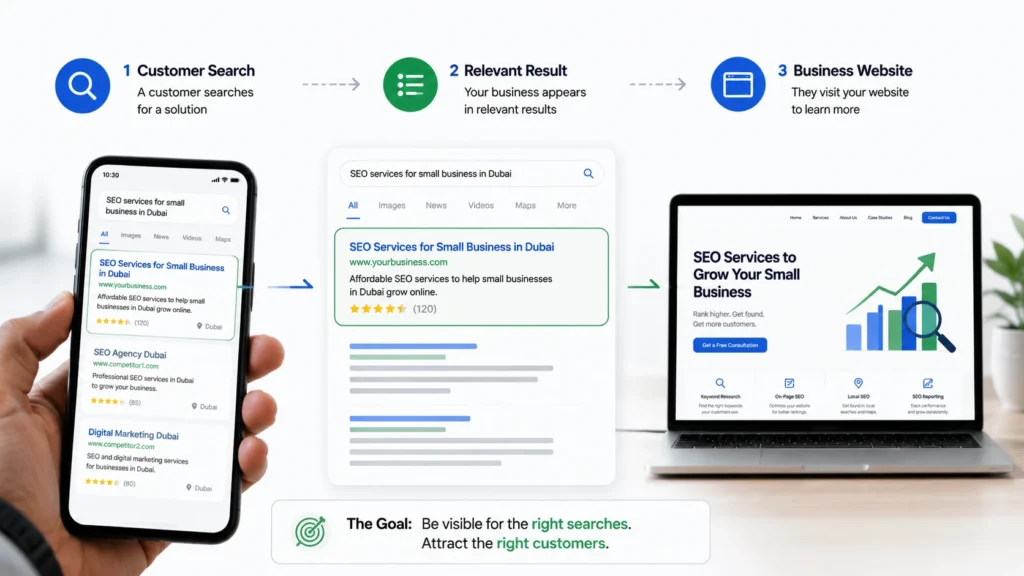
“SEO services for small business in Dubai”
This is very different from showing an advertisement to someone who may not be interested in SEO.
The searcher has identified a problem and is actively looking for a solution.
SEO helps your business become visible for relevant searches like these.
The goal is not to rank for every possible keyword. The goal is to appear for searches that are relevant to your products, services, location, and customers.
That makes how to get my business found on Google a more useful question than simply asking how to increase rankings.
2. SEO Can Bring Customers Who Are Already Searching
One of the biggest benefits of SEO for business is its connection with search intent.
Consider someone searching:
“emergency plumber in Dubai”
They are probably not looking for general information about plumbing.
They have a problem and may need a service.
Now consider:
“how much does emergency plumbing cost in Dubai?”
This person may still be researching, but they are closer to making a decision.
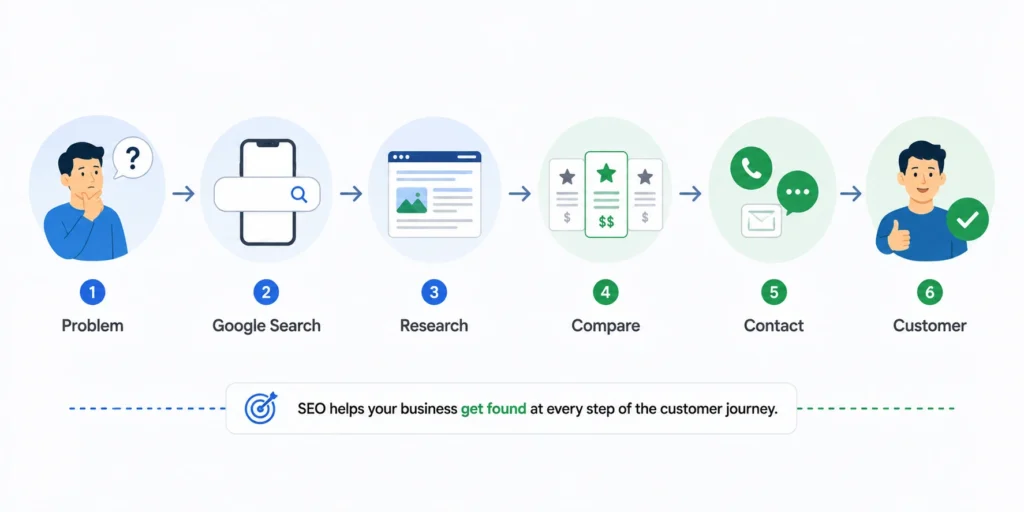
This is why businesses should target different stages of the customer journey.
Useful SEO content can reach people when they are:
- Identifying a problem
- Researching solutions
- Comparing businesses
- Checking prices
- Looking for reviews
- Choosing a provider
- Ready to contact a business
So, if you ask how can SEO help my business, one answer is that it can put your business in front of people who are already looking for solutions you provide.
Search intent matters
Not every search has the same commercial value.
Someone searching:
“what is SEO?”
is probably learning.
Someone searching:
“SEO services for small business”
is researching a solution.
Someone searching:
“hire SEO consultant in Dubai”
may be ready to contact a provider.
A good SEO strategy considers these differences rather than treating every keyword equally.
3. SEO Can Increase Relevant Website Traffic
More website traffic is not automatically better.
A website can receive thousands of visitors and still generate very few customers if those visitors are not interested in what the business offers.
The real goal is relevant organic traffic.
Imagine a local dental clinic receives visitors from searches such as:
- dentist in Dubai
- dental clinic near me
- teeth cleaning in Dubai
- emergency dentist Dubai
- dental implants Dubai
Those visitors have a stronger connection to the clinic’s services than someone searching for general information about dental health.
This is why SEO should focus on search intent and qualified traffic, not just visitor numbers.
A successful SEO campaign should aim to bring people who have a realistic reason to consider your business.
Why qualified traffic matters
Suppose two websites each receive 1,000 visitors.
Website A receives visitors who are not interested in its services.
Website B receives visitors who are actively looking for the services it provides.
The second website may generate more enquiries even with the same amount of traffic.
This is why SEO for business should focus on attracting the right visitors, not simply increasing the number shown in an analytics report.
4. SEO Can Help Generate Leads and Enquiries
If you are asking how does SEO help businesses get customers, lead generation is one of the most important answers.
A visitor does not always become a customer immediately.
They may first:
- Call your business
- Send a WhatsApp message
- Fill out a contact form
- Request a quotation
- Book an appointment
- Ask for pricing
- Visit your location
- Download information
- Compare your service with competitors
These actions can become business leads.
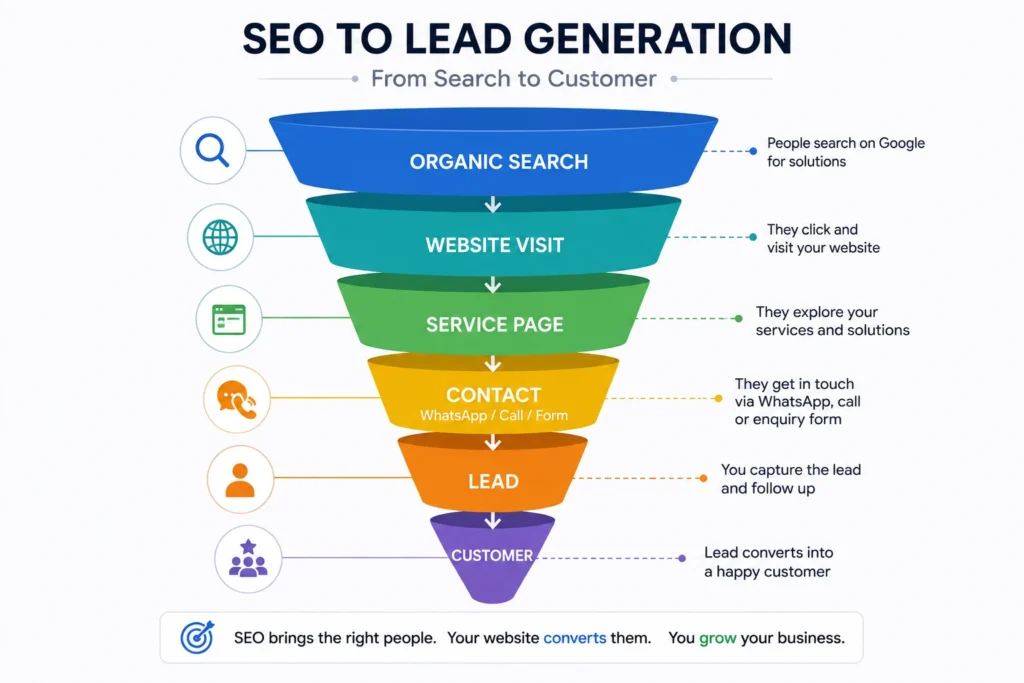
This means an SEO strategy should not stop at search rankings. The work should connect search visibility with relevant traffic, enquiries, and business goals. If you are considering professional SEO services for your business, the strategy should be based on your industry, target audience, location, competition, and conversion goals.
The journey should look more like:
Search → Website or Google Business Profile → Information → Trust → Enquiry → Customer
If your website ranks well but makes it difficult for visitors to contact you, the SEO opportunity is incomplete.
Strong service pages, clear calls to action, useful information, reviews, contact details, and a good user experience all help turn search visibility into potential business.
5. Local SEO Helps Nearby Customers Find Your Business
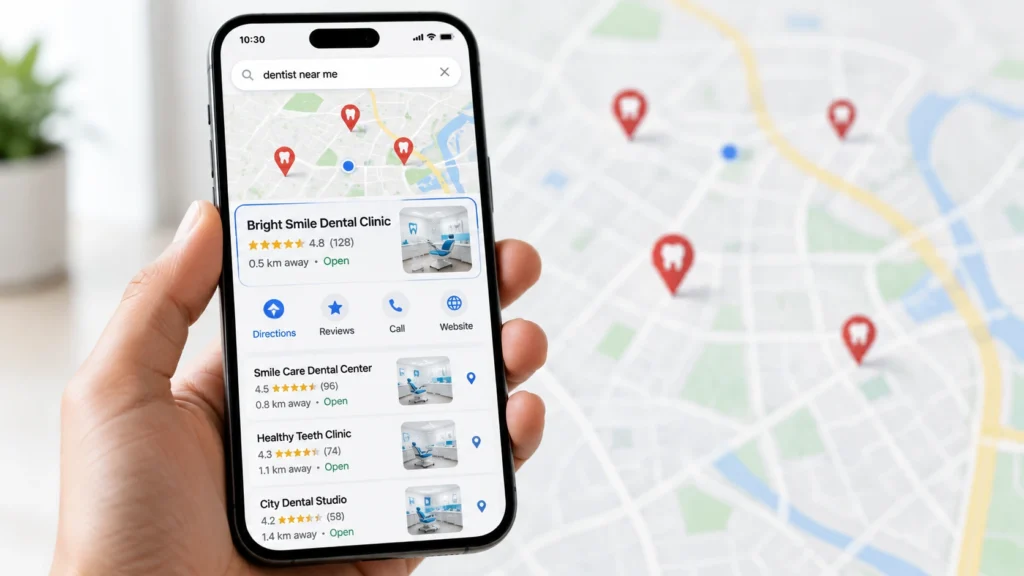
For a local business, local SEO for small business can be especially valuable.
People often include locations in their searches:
- SEO consultant in Dubai
- restaurant in Thrissur
- dentist near me
- car rental in Kunnamkulam
- best salon in Kochi
- accountant in Dubai
They may also search through Google Maps.
This makes your Google Business Profile an important part of your local online presence.
Local SEO can involve:
- Google Business Profile optimization
- Accurate business information
- Local service pages
- Location-specific content
- Customer reviews
- Local citations
- Relevant local links
- Consistent business details
- Local search optimization
For businesses that depend on nearby customers, local SEO can help increase visibility for searches with strong local intent.
Someone searching “car rental near me” is potentially much closer to becoming a customer than someone casually reading a general article about cars.
That difference in intent matters.
6. SEO Helps Build Trust Before a Customer Contacts You
A customer may not contact your business immediately after finding it in Google.
They may investigate first.
They might check:
- Your website
- Google Business Profile
- Reviews
- Service pages
- Pricing information
- Testimonials
- Photos
- Business information
- Other websites mentioning your brand
This means search visibility can contribute to the trust-building process.
Imagine a potential customer searches for your service and finds your business in several useful places. They see a professional website, clear service information, genuine reviews, location details, and helpful content answering their questions.
That gives them more information to make a decision.
SEO cannot guarantee that someone will trust or choose your business.
But good SEO can help make your business easier to discover and easier to evaluate.
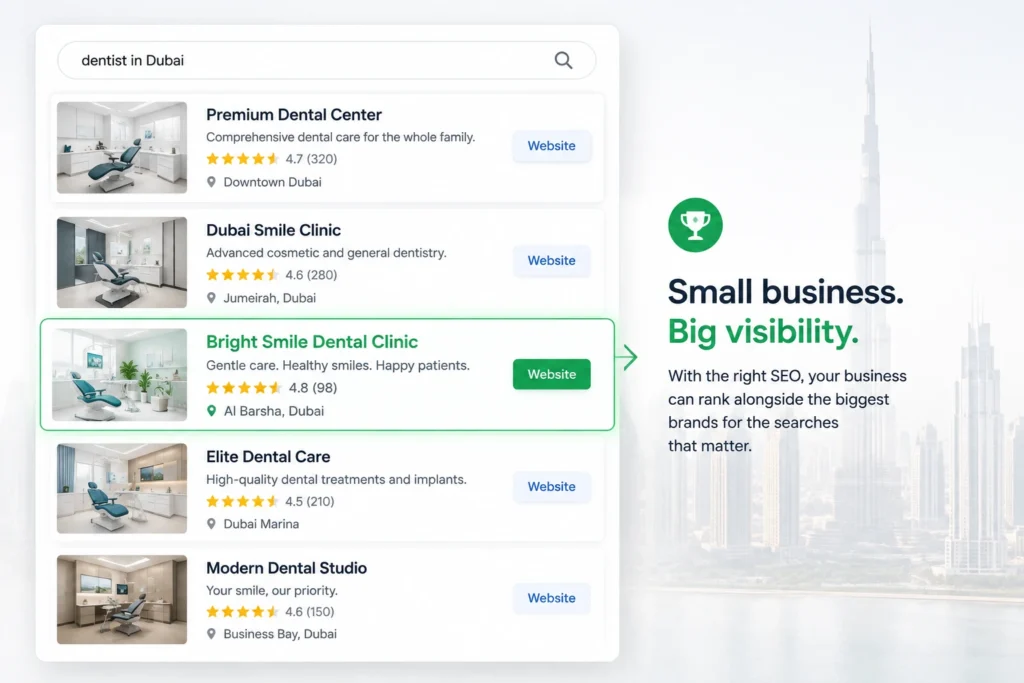
7. SEO Gives Small Businesses a Chance to Compete
Large companies often have bigger marketing budgets.
That does not mean a small business cannot compete in search.
Instead of trying to rank for extremely broad terms, a smaller business can focus on specific searches related to:
- A particular service
- A specific location
- A customer problem
- A particular product
- A specific industry
- A defined audience
For example, instead of targeting only:
“accountant”
a small business could target searches such as:
“accountant for small business in Dubai”
or:
“tax consultant for small businesses in Dubai”
These longer, more specific searches can reveal stronger intent.
This is one reason SEO for small business should not simply copy the strategy used by large national brands.
The strategy should reflect the business’s actual customers, market, location, services, and competitive position.
8. SEO Can Reduce Dependence on Paid Advertising
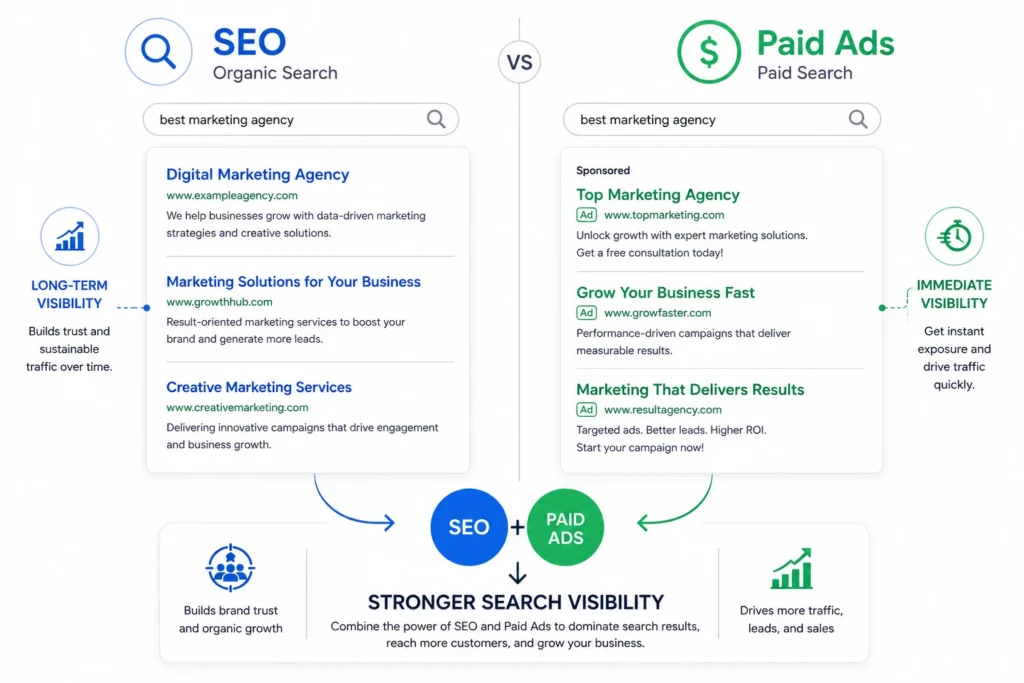
Many business owners compare SEO with Google Ads and ask:
“Should I invest in SEO or paid advertising?”
The two channels work differently.
Paid search can put your business in front of potential customers quickly, but you generally pay for the traffic generated through the advertising campaign.
SEO focuses on earning organic visibility.
That means the comparison should not always be:
SEO vs Google Ads
It can instead be:
SEO + Google Ads
Paid advertising can support immediate campaigns, product launches, promotions, or high-priority services.
SEO can build organic visibility for relevant searches over time.
For a business with a long-term growth plan, having both organic and paid search visibility can reduce dependence on a single acquisition channel.
The important point is that SEO should be judged against business goals, not treated as a replacement for every other marketing activity.
9. SEO Can Create Long-Term Marketing Value
One reason businesses ask is SEO worth it for my business is because SEO does not normally produce instant results.
A paid campaign can start generating traffic soon after it launches.
SEO usually requires time to improve a website’s technical foundation, content, relevance, authority, and search visibility.
But useful SEO assets can continue working after they are created.
For example, a well-optimized service page may continue attracting organic visitors months after publication.
A useful article may rank for several related searches.
A strong local presence may continue generating discovery through Google Search and Maps.
This does not mean SEO results are permanent or guaranteed.
Search rankings can change. Competitors can improve. Search algorithms can change. Customer behaviour can change.
SEO therefore needs ongoing monitoring and improvement.
The value comes from building an organic acquisition channel rather than paying for every visit individually.
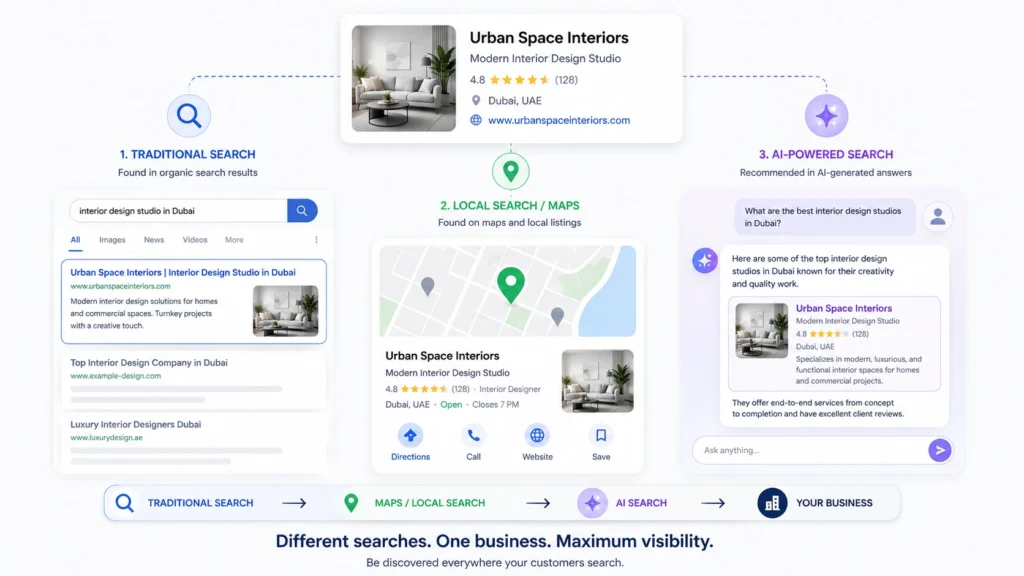
10. SEO Is Expanding Beyond Traditional Google Results
Search behaviour is changing.
SEO itself has also changed considerably over the years. What worked for search engines in the past is not necessarily enough today. If you want to understand how SEO has changed over time, you can read more about the evolution of SEO and how search has moved beyond simple keyword matching.
That creates another reason why does my business need SEO should be considered from a broader perspective.
Modern search visibility can involve:
- Traditional organic search
- Local search
- Google Maps
- Featured results
- AI-generated answers
- Conversational search
- Brand mentions
- Entity information
- Structured data
- Helpful content
This is where concepts such as AI SEO, Answer Engine Optimization (AEO), and Generative Engine Optimization (GEO) are becoming part of the wider search conversation.
The exact systems used by AI platforms can change, but the basic requirement remains useful information from credible and understandable sources.
A business that clearly communicates who it is, what it offers, where it operates, and why customers should trust it has a stronger foundation for modern search visibility.
Is SEO Worth It for My Business?
There is no universal answer to is SEO worth it for my business.
SEO can make sense when:
- People search online for your products or services
- Your competitors are already visible in search
- Your business depends on enquiries or bookings
- You serve a defined local area
- Your website can generate leads
- You want to build a long-term acquisition channel
- You have enough time to wait for organic growth
- Your customer lifetime value can support the investment
SEO may not be the best first option when nobody searches for your category or when you need immediate leads within days.
In those situations, paid advertising, partnerships, outbound sales, social media, or other channels may be more suitable.
The right question is not:
“Does every business need SEO?”
The better question is:
“Do my potential customers use search engines when they need what I sell?”
If they do, your search visibility deserves attention.
How Long Does SEO Take to Show Results?
Another common long-tail question is:
“How long does SEO take to show results?”
There is no fixed answer.
The timeline can depend on:
- Website age
- Existing authority
- Competition
- Search demand
- Website quality
- Technical problems
- Content quality
- Local competition
- Industry
- Target location
- SEO implementation
A new website competing for difficult national keywords may require considerably more work than an established local business targeting a specific service and city.
SEO should therefore be evaluated using progress over time rather than an arbitrary promise of first-page rankings within a fixed number of days.
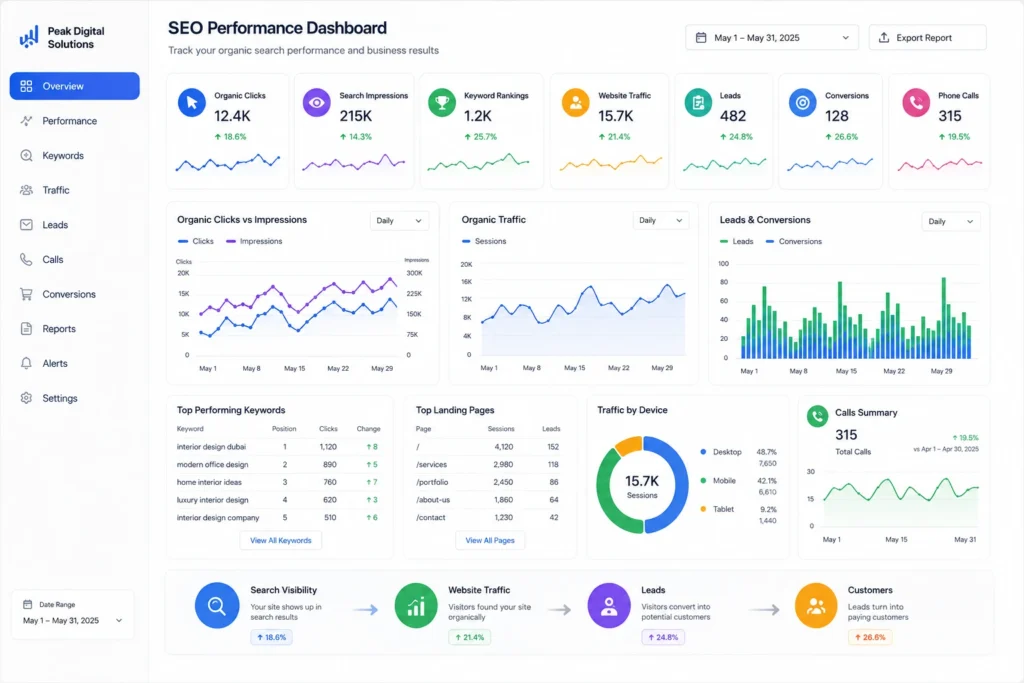
Look at changes in:
- Organic impressions
- Organic clicks
- Keyword visibility
- Search positions
- Relevant landing-page traffic
- Leads
- Calls
- Form submissions
- Bookings
- Google Business Profile actions
- Revenue where conversion tracking is available
How Do I Know If My SEO Is Working?
This is where many businesses make a mistake.
They focus only on rankings.
Rankings matter, but they are not the final business objective.
Suppose your website moves from position 40 to position 8.
That is a meaningful improvement.
But if the keyword has almost no search demand, it may have little business value.
Now imagine another keyword moves from position 8 to position 3 and starts generating calls, enquiries, and sales.
That improvement has a much clearer commercial impact.
The best way to measure SEO is to connect search performance with customer actions.
Think beyond:
“Where do I rank?”
and ask:
“What business results are coming from the visibility I am gaining?”
What If My Business Already Ranks on Google?
You may already rank on Google’s first page and still have SEO opportunities.
Your website could rank for informational searches but not commercial searches.
Your competitors may receive more clicks from similar rankings.
Your Google Business Profile may not be well optimized.
Your service pages may not target the searches customers actually use.
Your website may receive traffic but convert very few visitors into enquiries.
You may also have opportunities to improve:
- Search visibility
- Click-through rates
- Service pages
- Internal links
- Local pages
- Content
- Technical SEO
- Conversion paths
- Reviews and reputation
- Business information
SEO is therefore not only about taking a website from page ten to page one.
It is also about getting more value from the visibility your business already has.
Why Does My Business Need SEO? The Simple Answer
So, why does my business need SEO?
Because your customers may already be searching for the products, services, and solutions you provide.
If they cannot find your business, they can easily find a competitor instead.
SEO can help your business:
- Become easier to find on Google
- Reach people actively searching for your services
- Increase relevant organic traffic
- Generate leads and enquiries
- Reach nearby customers through local search
- Build trust before the first contact
- Compete for specific high-intent searches
- Reduce dependence on paid traffic
- Build long-term organic visibility
- Prepare your online presence for changing search behaviour
But SEO should never be reduced to rankings alone.
The real journey is:
Search → Discovery → Website or Maps → Trust → Enquiry → Customer
That is the connection between SEO and business growth.
Final Thoughts
If you have been asking why does my business need SEO, start with your customers.
Find out what they search before contacting a business like yours.
What problems are they trying to solve?
What services are they comparing?
What questions do they ask?
What location do they search?
What information do they need before making a decision?
Those questions can become the foundation of your SEO strategy.
SEO is not a guarantee of instant customers. It is not simply adding keywords to a website. And it is not only about reaching position one.
Good SEO connects your business with relevant searches, useful information, local discovery, trust signals, and conversion opportunities.
If your potential customers are already searching for what you sell, the bigger question may not be why does my business need SEO.
It may be:
How many potential customers are finding my competitors instead of me?
If you are looking for an SEO expert to help improve your business’s search visibility, you can learn more about the SEO approach, experience, and services available.