
This blog explains the importance of content SEO and how to create useful, search-friendly content for Google and AI-powered search systems. It covers search intent, IDF scoring, atomic sentences, semantic SEO, entity-based SEO, passage-level retrieval, RAG, synthetic query generation, information gain, GEO and AEO. It also provides practical steps for content optimisation, internal linking, measuring SEO performance and improving organic visibility through clear, relevant and trustworthy content.
Content SEO helps your website reach people who are searching for your products, services or information. It combines useful writing with keyword research, search intent, content structure and website optimisation.
But content SEO is no longer just about adding keywords to a blog post.
Modern search systems can interpret meaning, identify relationships between topics and retrieve relevant sections from web pages. AI-powered search experiences can also use information from websites to prepare answers.
This changes how we should plan and write website content.
A good article should answer the reader’s question clearly. It should explain related topics, provide reliable information and offer something useful beyond what competing pages already say.
For businesses, this creates an opportunity to attract relevant visitors and turn some of them into enquiries.
In this guide, I will explain why content SEO matters, how modern search systems interpret content, and how to create useful content for Google and AI-powered search platforms.
What Is Content SEO?
Content SEO is the process of planning, writing, organising and improving website content to help search engines connect it with relevant searches.
It includes blog posts, service pages, product descriptions, landing pages and other useful information on a website.
A good content SEO strategy considers five main areas:
- Search intent: What does the reader want to know or do?
- Keyword research: Which words and phrases describe the topic?
- Content quality: Does the page provide accurate and useful information?
- Content structure: Can readers understand the page easily?
- Internal linking: Can readers and search engines discover related pages?
For example, imagine someone searching for an SEO expert in Kerala.
A useful service page should explain the SEO services offered, the problems they solve and how businesses can get started. A page that only repeats the phrase “SEO expert in Kerala” will not provide enough information.
Content SEO connects the words people search for with the answers they need.
If you want to improve your website’s organic visibility, you can learn more about SEO services.
Why Is Content SEO Important?
Content SEO supports website visibility, relevant traffic, customer trust and business growth. Its value depends on how well the content serves the audience and the website’s goals.
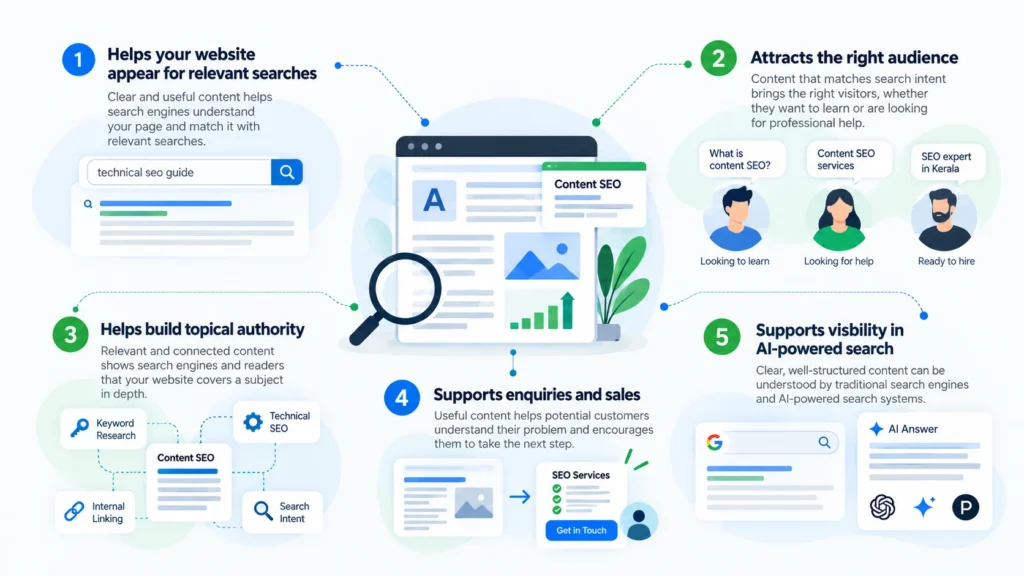
1. Helps your website appear for relevant searches
Search engines need to understand what a page covers before they can determine whether it is relevant to a search.
Descriptive titles, clear headings, useful paragraphs and relevant terminology help explain the page’s subject.
For example, a guide about technical SEO may discuss crawling, indexing, XML sitemaps, canonical tags and internal links. These concepts help explain the subject when they are used correctly and in context.
The goal is not to mention as many terms as possible. The goal is to answer the reader’s question properly.
2. Attracts the right audience
Not every visitor has the same goal.
Someone searching “what is content SEO” probably wants to learn. Someone searching “content SEO services” may be looking for professional help.
Your content should match that intent.
An educational article should explain the topic. A service page should explain the service, its benefits and the next step.
When the content matches the searcher’s needs, visitors have a better chance of finding what they came for.
3. Helps build topical authority
Topical authority refers to how well a website covers a subject through relevant, useful content.
For example, an SEO website may publish articles about keyword research, content SEO, technical SEO, internal linking and search intent.
These articles can connect through relevant internal links. Readers can move from one subject to another without starting a new search.
This structure also helps search engines discover related pages and understand their context.
Publishing more articles does not automatically create topical authority. Each page should serve a clear purpose and contribute something useful.
4. Supports enquiries and sales
Useful content can help potential customers understand a problem before they contact a business.
A local business might read a guide about Google Business Profile optimisation. If the guide answers their questions, they may consider hiring an SEO professional.
This is where educational content and service pages work together.
A blog attracts readers who need information. A relevant service page explains how you can help them solve the problem.
For businesses that need better visibility in local searches, local SEO services provide a relevant next step.
5. Supports visibility in AI-powered search
People now use traditional search results alongside AI-generated summaries and answers.
These systems can interpret questions, retrieve relevant information and combine information from different sources.
Clear content gives readers and search systems a better chance of understanding what a page offers.
However, no particular writing technique guarantees that Google or an AI platform will rank, retrieve or cite a page. Content quality, relevance, accessibility and other factors still matter.
How Has Content SEO Changed With Modern Search Systems?
Traditional keyword optimisation remains useful, but modern search systems can do more than match exact words.
They can interpret language, analyse relationships between concepts and identify sections that answer specific questions.
Understanding these developments can help you create better content without relying on keyword repetition.
1. Search intent and semantic search
Semantic search focuses on the meaning and context of a query.
Consider these searches:
- What is content SEO?
- Why is content optimisation important?
- How do I improve my blog rankings?
- How can I write better SEO content?
The wording differs, but the searches share related needs.
A useful guide can answer several of these questions within one article. It does not need a separate page for every variation.
Start with the main search intent. Then identify the related questions readers may ask.
This helps you create content that covers a subject naturally.
2. IDF scoring and natural keyword distribution
IDF stands for Inverse Document Frequency. It is a statistical measure used in information retrieval to estimate how informative a term is across a collection of documents.
Common words often appear in many documents. More specific terms can help distinguish one subject from another.
For example, an article about content SEO may naturally discuss:
- Search intent
- Keyword research
- Internal linking
- Passage retrieval
- Entity relationships
- Content audits
- Information gain
These terms should appear where they help explain the topic.
IDF is not a universal keyword-density formula. Google does not publish a required IDF score that content writers must achieve.
An IDF-informed workflow can still help SEO professionals compare relevant documents, identify topic-specific vocabulary and find gaps in their own content.
A practical process is:
- Collect relevant competing pages.
- Identify the terms and concepts that appear across those pages.
- Separate generic words from more specific topic terms.
- Check which useful concepts your article does not cover.
- Add missing information where it genuinely helps readers.
Do not force every term into the article. Natural use and clear explanations matter more than keyword frequency.
3. Atomic sentences and clear paragraphs
Atomic sentences express one main idea with enough context to make the meaning clear.
Consider this example:
Weak: “This improves it and makes it work better.”
The reader may not know what “this” refers to.
Clear: “Internal links help visitors discover related pages on a website.”
The second sentence identifies the subject and explains what it does.
Atomic writing is useful for definitions, tutorials, FAQs and technical explanations. It can also make sections easier to understand when they are retrieved separately from a longer article.
Follow three simple rules:
- Keep each sentence focused on one main idea.
- Keep related sentences together.
- Name the subject instead of relying on unclear references.
Atomic writing does not mean every sentence must be short. It means every sentence should communicate its point clearly.
4. Entity-based SEO and topic relationships
An entity is a clearly identifiable person, organisation, place, product or concept.
For example, an article about SEO may mention Google Search Console, Google Search, keyword research and internal linking.
These entities provide context. Their relationships help explain the subject.
Simply naming a tool does not make an article useful. The article should explain how the tool relates to the topic.
For example, a guide about Google Search Console can explain how website owners use search queries, impressions and clicks to review organic search performance.
Entity-based optimisation focuses on accurate information and meaningful relationships between concepts.
5. Passage-level retrieval
Passage-level retrieval refers to finding relevant sections within a larger document.
Imagine an article that covers keyword research, internal linking, content audits and search intent.
A reader searches, “How do I find missing topics in an SEO article?”
A section explaining content gap analysis may answer the question directly. The reader does not necessarily need every other section of the article.
This is why content structure matters.
Use descriptive H2 and H3 headings. Begin each section with a direct explanation. Follow it with examples, steps and supporting information.
For example, a heading such as “How to Find Content Gaps in Existing Articles” is more informative than “Another Important Method.”
Each section should make sense on its own while contributing to the larger topic.
6. Retrieval-Augmented Generation (RAG)
Retrieval-Augmented Generation, or RAG, combines information retrieval with AI-generated responses.
A simplified RAG workflow has three stages:
- A system retrieves information relevant to a question.
- An AI model uses the retrieved information as context.
- The model generates a response based on that context and its other capabilities.
This method can help an AI system use external information when preparing an answer.
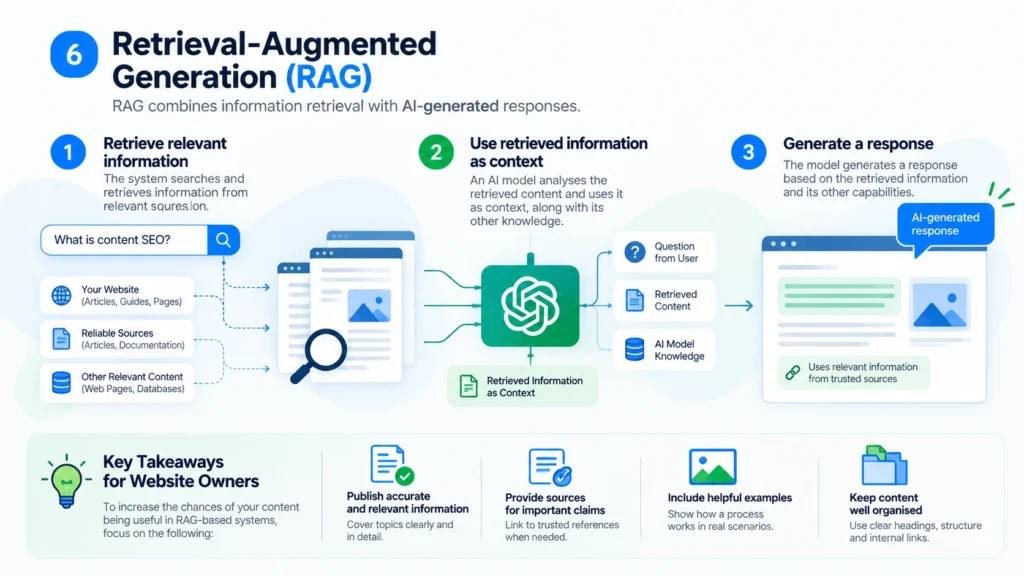
For website owners, the practical lesson is to publish accurate, relevant and well-organised information.
Explain claims clearly. Provide sources for factual statements that need evidence. Include examples that demonstrate how a process works.
These practices make content more useful, although they do not guarantee that a particular AI system will retrieve or cite your page.
7. Synthetic queries and query expansion
People often ask the same question in different ways.
For example, a person may search for “content SEO strategy.” Another may ask, “How do I optimise my blog posts for Google?”
Synthetic query generation involves creating possible queries automatically. Query expansion involves adding related terms or alternative wording to improve information retrieval.
These are concepts from information retrieval and AI systems. They should not be confused with a confirmed checklist of Google ranking factors.
You can apply the underlying idea to content planning.
For an article about content SEO, consider related questions:
- How do I optimise existing content?
- Why is search intent important?
- How do internal links help SEO?
- How do I measure content performance?
- How often should I update a blog post?
Answer the questions that fit the article’s purpose. One useful article can cover several related searches without repeating the same information.
8. PMI and related-term relationships
PMI stands for Pointwise Mutual Information. It is a statistical measure of how strongly two terms are associated compared with what would be expected if they occurred independently.
For content analysis, term relationships can help reveal useful patterns.
For example, “internal linking” may appear alongside “site structure,” “crawlability” and “related pages” in discussions about SEO.
These relationships can help a writer identify relevant supporting concepts.
However, PMI should not be presented as a publicly confirmed Google ranking score. It is an analytical concept that can help explain relationships between terms.
The practical lesson is simple: explain how related concepts work together instead of listing them without context.
9. Thematic clustering and internal linking
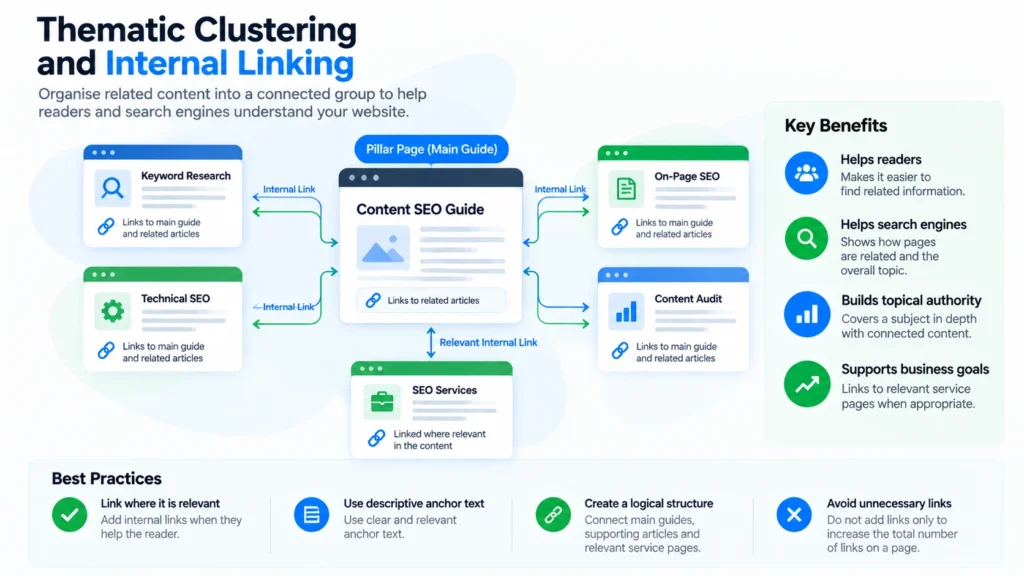
Thematic clustering means organising related content into a connected group.
For example, an SEO website might have a main guide about content SEO and supporting articles about keyword research, technical SEO, on-page SEO and content audits.
The main guide can link to the relevant supporting articles. Those articles can link back to the main guide where useful.
This structure helps readers discover related information. It also helps search engines find pages and understand how they relate.
Internal links should serve a purpose. Avoid adding links only to increase the total number of links on a page.
You can also connect your educational content with your on-page SEO services when the surrounding discussion is relevant to that service.
10. GINGER and synthetic query expansion
The modern SEO discussion also includes specialised approaches to retrieval refinement and semantic query expansion, including GINGER as described in some SEO material.
These concepts relate to the broader goal of matching a user’s question with relevant information.
The exact methods used by individual search systems may differ. GINGER should not be treated as a confirmed Google ranking factor without reliable supporting evidence.
For content creators, the useful approach is to understand the reader’s needs and organise information accordingly.
For example, a page about local SEO may answer questions about Google Business Profile optimisation, local keyword research, business information and customer reviews.
These topics are related, but each section should explain its own subject clearly.
The main takeaway: You do not need to know every detail of a search engine’s internal systems to write useful content. Clear answers, relevant context and well-organised information are practical starting points.
What Is Information Gain in Content SEO?
Information gain is the additional value a reader receives from your content beyond what they already know or can easily find elsewhere.
It is a useful principle for creating content that stands out from competing pages.
Imagine that ten articles explain the importance of content SEO. If your article repeats the same definition and generic recommendations, it gives readers little reason to choose it.
You can add more value through:
- Practical examples of content optimisation.
- A step-by-step content audit process.
- Original screenshots or verified data.
- A clear comparison of weak and improved writing.
- Lessons from real SEO projects.
- Useful checklists that readers can apply immediately.
For example, a basic recommendation might say, “Use relevant keywords in your content.”
A stronger explanation shows how to identify search intent, review competing pages, find missing subtopics and improve a paragraph without repeating the same phrase.
The second explanation gives the reader a process to follow.
Before publishing, ask yourself: What does this article offer that a reader would not get from a basic summary of the topic?
Your answer can guide the improvements that make the article more useful.
How to Write Content for Google and AI Search
You do not need to write a separate article for every search platform. Start by creating useful information that people can understand and search systems can access.
Step 1: Research the search intent
Identify what the reader wants to achieve.
Review the search results for your primary keyword. Look at the types of pages that appear and the questions they answer.
Decide whether the search is informational, commercial or transactional.
Use that information to plan the page.
Step 2: Create a useful content outline
Organise the article around the main question and its supporting topics.
Use clear headings that describe the content below them.
Avoid headings that sound interesting but do not tell readers what they will learn.
Step 3: Answer questions directly
Start each section with a clear answer or explanation.
Then add supporting details, examples or steps.
This helps readers find information quickly and gives each section a clear purpose.
Step 4: Use related terms naturally
Include terminology that helps explain the topic.
For a content SEO guide, related terms may include organic traffic, search intent, internal links, content audits and semantic search.
Do not repeat the main keyword in every heading. Use it where it fits naturally.
Step 5: Add reliable evidence
Support important claims with trustworthy sources.
Use official documentation for search guidelines and technical details. Use first-hand experience for case studies and practical recommendations.
When including statistics, provide their source and date.
Never invent figures or results to make an article appear more convincing.
Step 6: Make the page accessible
Check that search engines can access the page and follow its internal links.
Use descriptive titles, logical headings and useful image alt text.
Add structured data when the page qualifies for a supported schema type.
If technical issues prevent a page from being crawled or indexed, useful writing alone may not solve the problem. Technical SEO services cover website issues that can affect search accessibility.
Step 7: Review the article before publishing
Check for unclear sentences, missing topics, repeated ideas and unsupported claims.
Make sure the article answers the original search intent.
Review the page on mobile devices. Confirm that the headings, paragraphs, links and images are easy to use.
How Does E-E-A-T Support Content Quality?
E-E-A-T stands for Experience, Expertise, Authoritativeness and Trustworthiness.
Google uses these concepts in its content quality guidance. E-E-A-T is not a single ranking factor.
Each part has a practical meaning.
Experience: Show relevant first-hand experience when appropriate. A case study can explain the problem, the changes made and the observed results.
Expertise: Explain the subject accurately. Use technical terms when needed, but make their meaning clear to beginners.
Authoritativeness: Help readers understand why the author or publisher is qualified to discuss the topic. Relevant work, credible references and recognition from others can support this.
Trustworthiness: Keep information accurate. Cite sources when necessary. Represent your work and results honestly.
For example, an SEO case study should explain the website’s starting point, the changes made, the reporting period and the results observed.
A statement such as “Organic traffic increased by 40%” is more useful when it includes a clear timeframe and verifiable evidence.
Do not invent credentials, results or customer experiences. Trust depends on accurate information.
How to Measure Content SEO Performance
Publishing an article is only the beginning. You need to measure whether it reaches the right audience and supports your goals.
Google Search Console
Use Google Search Console to review:
- Search queries.
- Impressions and clicks.
- Click-through rate.
- Average search position.
- Page-level search performance.
Compare relevant periods to identify changes and opportunities.
Google Analytics 4
Use Google Analytics 4 to measure organic landing-page sessions and relevant user actions.
Depending on your website, these actions may include contact form submissions, calls, purchases or other conversions.
Content audits
Review existing pages for outdated information, missing topics, unclear sections, broken links and unnecessary repetition.
A content audit can help identify pages that need an update, pages that overlap and opportunities for better internal linking.
Conversion tracking
Measure enquiries and other business outcomes where relevant.
A page may attract traffic but generate few enquiries. In that case, review whether the content reaches the right audience and whether the next step is clear.
An SEO audit can help identify content gaps and technical issues that need attention.
Do not judge content performance by rankings alone. Measure whether the page attracts relevant visitors and helps them achieve their goals.
Common Content SEO Mistakes to Avoid
Even well-written content can underperform when it fails to meet the reader’s needs.
Keyword stuffing: Repeating the same phrase unnaturally makes content difficult to read. Use terms where they fit the meaning.
Generic content: Rewriting what competing pages already say adds little value. Include useful examples, evidence or original analysis.
Unclear headings: Generic headings make it harder to understand what each section covers. Describe the subject directly.
Unfocused paragraphs: Mixing unrelated topics weakens clarity. Keep each paragraph centred on one main idea.
Unnatural entity usage: Mentioning tools or technical concepts without explaining their relevance does not improve the article.
Ignoring search intent: A page can contain accurate information and still fail to answer the question that brought the reader to it.
Publishing without review: Check facts, links, spelling, mobile readability and accessibility before publishing.
Updating content without a reason: Make changes when information, user needs or performance data justify them.
Expecting instant results: Search performance depends on multiple factors. Track meaningful changes over time rather than expecting immediate rankings.
Content SEO Checklist Before Publishing
Use this checklist when publishing a new article or updating an existing page.
Search Intent and Keyword Strategy
- The primary search intent is clear.
- The primary keyword and related search queries are identified.
- The content format matches the searcher’s needs.
- The SEO title accurately describes the page.
- The meta description is relevant and encourages qualified clicks.
- The introduction explains the main topic and addresses the reader’s needs.
Content Quality and Semantic Relevance
- Each major heading covers a relevant subtopic.
- Sentences provide enough context to be understood independently.
- Related terms, entities, and concepts appear naturally.
- Important questions receive direct answers.
- The article adds value beyond basic competitor summaries.
- Original examples, experience, data, or practical advice are included where relevant.
- Claims and statistics have reliable sources.
- The content avoids unnecessary repetition and unsupported claims.
E-E-A-T and Topical Authority
- The author’s identity and relevant experience are clear where appropriate.
- Credentials, references, case studies, or other trust signals support important claims.
- The article connects naturally with relevant pages on the website.
- The content supports the site’s main topics and topical coverage.
- Potential content gaps and keyword cannibalization have been checked.
On-Page and Technical SEO
- The URL is descriptive and appropriate.
- The heading structure is logical, with a clear H1.
- Relevant internal links help readers find related pages.
- External links support claims or provide useful additional information.
- The page is indexable and has the correct canonical URL.
- Relevant schema markup is valid and matches visible content.
- The page is included in the sitemap where appropriate.
Google and AI Search Readiness
- Important entities and their relationships are clearly explained.
- Key questions have concise, factual answers.
- Important passages provide enough context to stand on their own.
- Facts, definitions, and recommendations are easy to distinguish.
- Sources are identified for claims that need verification.
- Content helps users rather than merely targeting search engines or AI systems.
Images and User Experience
- Images are relevant and add value.
- Useful images have descriptive alt text.
- Image filenames, dimensions, formats, and file sizes are appropriate.
- The page is readable and usable on mobile devices.
- Page performance and loading experience have been checked.
- The layout is easy to scan, with readable paragraphs and clear headings.
- A relevant CTA supports the reader’s next step.
Measurement and Final Review
- Organic traffic, visibility, and relevant conversions can be measured.
- Tracking works correctly where measurement is required.
- The final draft has been checked for accuracy, grammar, and repetition.
- All links, images, buttons, and important page elements work.
- A review date or update trigger is set where appropriate.
After Publishing
- The URL is checked for indexability and submitted for indexing when appropriate.
- Search Console performance is reviewed after sufficient data becomes available.
- Organic clicks, impressions, relevant queries, and conversions are monitored.
- Content is updated when facts, user needs, or search results change.
Create Content That Helps People and Supports SEO
Content SEO is about creating useful information that people can find, understand and trust.
It starts with search intent and keyword research. It continues with clear writing, relevant terminology, useful internal links and accurate information.
Modern concepts such as atomic sentences, IDF, entity-based SEO, passage retrieval, RAG, thematic clustering and synthetic query generation help explain how information can be organised and retrieved by search systems.
These concepts can improve the way you plan and analyse content. They should not be treated as guaranteed ranking formulas.
The strongest content answers real questions, provides additional value and makes the next step clear.
If you want to improve your website’s organic visibility, start by reviewing your existing pages. Find missing answers, remove unnecessary repetition, add reliable evidence and improve the structure of each page.
Good content SEO is not about writing more words. It is about making every section more useful.
If your website needs help with content optimisation, technical SEO or organic search visibility, Visit Us or explore our SEO services to find a suitable starting point.
Frequently Asked Questions About Content SEO
What is the main purpose of content SEO?
The main purpose of content SEO is to help search engines connect website pages with relevant searches. It also helps visitors find accurate answers and take useful next steps.
How is content SEO different from traditional SEO?
Content SEO focuses on planning, creating and improving website information. SEO is a broader field that also includes technical optimisation, off-page activities, site architecture and other work.
How many keywords should an SEO article contain?
There is no universal keyword count for an SEO article. Use the primary keyword naturally and include related terms when they help explain the topic.
Does content length affect SEO rankings?
Content length alone does not determine rankings. An article should be long enough to answer the reader’s question properly. Unnecessary paragraphs can make a page less useful.
How does IDF help with content optimisation?
IDF estimates how informative a term is across a collection of documents. IDF-informed analysis can help identify topic-specific terminology and content gaps. It should not be treated as a standalone Google ranking score.
Can AI-generated content rank on Google?
AI-assisted content can appear in search results when it provides useful, reliable information and follows Google’s policies. Using AI does not remove the need for accuracy, original value and appropriate review.
What is the difference between GEO and AEO?
GEO focuses on content visibility in AI-generated search experiences. AEO focuses on providing useful information for systems that answer questions directly. Their methods overlap, and neither guarantees visibility.
How often should I update SEO content?
Update content when information becomes outdated, user needs change, new evidence becomes available or performance data shows an opportunity. Not every page needs frequent updates.
What is the difference between content SEO and content marketing?
Content SEO focuses on making website content relevant and discoverable through search. Content marketing has a broader purpose. It uses content to educate audiences, build relationships and support business goals across different channels.